
The Ultimate Tenant Move-In Checklist for Maryland Landlords (2026 Edition)
Did you know that as of October 2026, a simple oversight in your move-in paperwork could leave your investment vulnerable to costly legal disputes? Managing a rental property in areas like Prince George’s County or Laurel requires more than just a handshake and a key exchange. It’s natural to feel a sense of dread when faced with the shifting landscape of state regulations. You deserve the peace of mind that comes from knowing every detail is handled correctly. By following a structured tenant move-in checklist for landlords maryland, you can transform a high-stress transition into a professional, secure start for both you and your new resident.
We understand the weight of responsibility you carry when managing your own assets. It's often overwhelming to track new mandates like the mandatory Tenants’ Bill of Rights or the expanded lead paint registration rules. This guide simplifies those complexities into a clear, Maryland-specific framework designed to document property conditions and ensure full legal compliance. We'll preview the essential steps for 2026, including the updated one-month security deposit limit and critical inspection protocols. By the end of this article, you'll have the tools to protect your property and build a positive, lasting relationship with your tenant from day one.
Key Takeaways
- Master the 2026 administrative requirements, including the one-month security deposit cap and mandatory Tenants’ Bill of Rights, to ensure your lease starts on a solid legal foundation.
- Learn how to conduct a thorough room-by-room walkthrough using our tenant move-in checklist for landlords maryland to document property conditions and honor the tenant's 15-day inspection right.
- Streamline the onboarding process by coordinating utility transfers with local providers like BGE or Pepco and providing a comprehensive welcome packet.
- Avoid common financial pitfalls and future eviction hurdles by establishing a clear, documented baseline for the property's state before the keys change hands.
- Discover how professional property management in Howard and Prince George’s counties can handle the complex 50-point move-in process for you, providing total peace of mind.
Beyond the Handshake: Why Your Maryland Move-In Process Matters
Are you treating your tenant's move-in day as a simple key exchange or a critical legal event? In Maryland's 2026 rental market, the difference between a casual handshake and a rigorous onboarding process can cost you thousands in lost revenue. A sloppy start doesn't just create confusion; it leaves your high-value investment exposed to avoidable risks. By implementing a standardized tenant move-in checklist for landlords maryland, you establish a clear, professional baseline that protects your property for years to come.
A professional start does more than secure your assets; it sets the emotional and behavioral tone for the entire tenancy. When a tenant sees that you've documented every detail, they understand that you are a diligent, hardworking landlord who expects the same level of care in return. This clarity often leads to better rent compliance and fewer maintenance disputes. If you want to transition from the stress of self-management to the security of professional oversight, mastering this initial phase is essential. Having a proven system in place provides the stabilizing force you need to navigate the complexities of local property laws.
The Legal Stakes in Maryland
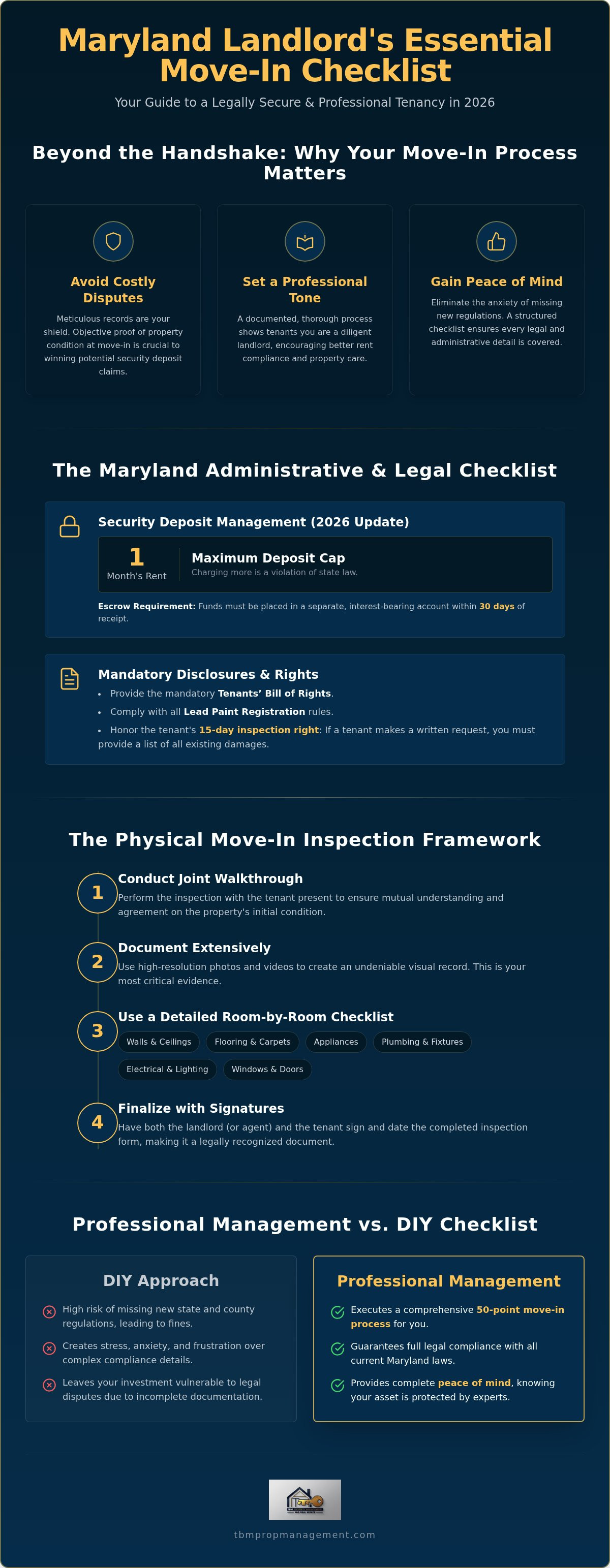
Maryland courts consistently favor landlords who maintain meticulous records. If you can't provide objective proof of a property's condition at the start of a lease agreement, your chances of winning a security deposit dispute are slim. Documentation is your only shield against claims that damages were "already there." Under Maryland Real Property Section 8-203.1, a landlord must provide the tenant with a written list of all existing damages within 15 days of occupancy if the tenant makes a written request. Failing to honor this rule isn't just a minor oversight; it's a legal hurdle that can prevent you from claiming legitimate repair costs during the move-out phase.
Emotional Relief Through Preparation
Do you ever feel a sense of dread that you've missed a county-specific licensing requirement or a new state disclosure? That anxiety is a common burden for those using a DIY approach. You can find immediate relief by adopting a professional asset manager mindset. Using a tenant move-in checklist for landlords maryland ensures that no detail, from lead paint certificates to local utility transfers, slips through the cracks. Our deep roots in Laurel and Prince George’s County mean we understand the hyper-local nuances that often trip up well-meaning owners. When you lean on a specialized, high-touch framework, you move from a state of frustration to a state of ease, knowing your property is well-protected by seasoned experts.
The Maryland Landlord’s Administrative & Legal Checklist
Are you certain your current lease package meets the rigorous 2026 standards for local compliance? The administrative phase of a tenancy is often the most taxing, yet it's where the foundation of your legal protection is built. In Maryland, missing a single mandatory disclosure or failing to register with the right county office can lead to steep fines and the inability to recoup losses later. Integrating these regulatory steps into your tenant move-in checklist for landlords maryland ensures you're not just filling a vacancy, but securing a legally sound investment.
Managing these requirements requires a diligent eye for detail, especially as state laws continue to evolve. From the shores of Anne Arundel to the busy corridors of Prince George’s County, every jurisdiction has its own set of hurdles. You don't have to carry this emotional burden alone. By following a structured framework, you can transition from the frustration of guesswork to the confidence of a seasoned professional.
Security Deposit Management
One of the most significant shifts in recent years is the reduction of the security deposit cap. As of October 2024, Maryland landlords cannot charge more than one month's rent for a security deposit. It's a common mistake to rely on outdated "two-month" rules, but doing so puts you in immediate violation of Maryland landlord-tenant laws. You must place these funds in a separate, interest-bearing escrow account within 30 days of receipt.
Proper receipting is equally critical. You're required to provide the tenant with a receipt that explicitly states their right to have the dwelling inspected by the landlord in the tenant's presence. This document must also outline the tenant's right to receive a written list of damages within 45 days after the tenancy ends. If you manage four or more units, remember that a new 2026 law requires you to provide an itemized, written disclosure of all potential fees before the lease is even signed.
Local Licensing & Registration
While state law provides the broad strokes, your local county often has the final say on habitability. In Prince George’s County, for example, you must secure a specific rental license before a tenant ever steps foot on the property. Montgomery County takes this a step further, requiring strict lead-free certifications for units built before 1978. As of October 2026, even owner-occupied homes with rooms for rent must register with the Maryland Department of the Environment (MDE) if they were built before 1978.
Ensuring your tenant receives the mandatory "Maryland Tenants' Bill of Rights" is now a non-negotiable step in the onboarding process. Understanding these nuances is why our guide on Maryland Landlord Tenant Rights is the essential foundation for your compliance strategy. If the prospect of tracking these county-specific filings feels overwhelming, our full-service property management team is here to handle the heavy lifting, providing the relief and professional oversight your asset deserves.
Conducting the Physical Move-In Inspection: A Room-by-Room Framework
The physical inspection is the moment your paperwork meets the reality of your property's condition. In Maryland, this isn't just a walkthrough; it's a high-stakes documentation process that protects your security deposit claims. Under state law, tenants have the right to be present during the move-in inspection if they request it in writing within 15 days of occupancy. Honoring this window prevents future claims that you were non-compliant or biased in your assessment. Using a robust tenant move-in checklist for landlords maryland ensures that every corner of the property is scrutinized before the first box is unpacked.
Your documentation strategy should be as detailed as possible to leave no room for ambiguity. While high-resolution photos are a standard requirement, we recommend a 4K video walkthrough for total clarity. Record yourself testing every appliance, from the dishwasher cycle to the oven's heating elements. Check the HVAC system for immediate responsiveness and inspect plumbing fixtures for slow drains or hidden leaks under sinks. For official resources and updates on these mandates, you can consult Maryland's Office of Tenant and Landlord Affairs.
The Smoke Detector Rule
Safety compliance in 2026 remains a top priority for local inspectors in Howard and Anne Arundel counties. Maryland law requires 10-year sealed battery smoke alarms in residential rental properties that do not have hardwired systems. These must be placed on every level of the home, including the basement, and specifically outside every sleeping area. You have a mandatory legal duty to test every smoke alarm on the day the tenant moves in to ensure the device is fully operational. Documenting this test in your inspection report provides a critical layer of liability protection.
Exterior and Utility Access
Don't overlook the property's perimeter and core systems. Check that all window locks are functional and that exterior lighting provides adequate safety for the entryway. This is also the perfect time to act as a dedicated partner by showing the tenant where the main water shut-off valve is located. Labeling these utilities clearly can prevent a small leak from turning into a catastrophic flood. Establishing this level of detail shows the tenant that you value the property's upkeep. Property maintenance starts with a perfect inspection, establishing a baseline that prevents future repair disputes and fosters a positive relationship from day one.
Finalizing Onboarding: Key Handover and Utility Transfer
How do you ensure you aren't left paying for a tenant's electricity long after they've moved in? The final stage of your tenant move-in checklist for landlords maryland is often the most logistically dense. It requires a delicate balance of administrative precision and welcoming hospitality. By confirming that all financial and utility obligations are met before the keys change hands, you eliminate the risk of "orphan" bills and establish a professional boundary from the very first hour.
This phase is where your diligent preparation pays off. You've already screened the tenant and inspected the property; now you're finalizing the execution of the lease. Collecting the first month’s rent and the security deposit in cleared funds is non-negotiable. Only once the payment is confirmed should you proceed with the distribution of keys, fobs, and garage openers. Tracking these items carefully ensures you don't face a security lapse or a costly re-keying bill at the end of the tenancy. Being detail-oriented now prevents a state of frustration later.
Utility Verification
Are the accounts actually in the tenant's name? Don't take their word for it. You should require a confirmation number or a screenshot of the active account from providers like BGE or Pepco before handing over the keys. In Howard and Anne Arundel counties, water bills often stay in the owner's name, so you must establish a clear system for billing the tenant back or ensuring they've registered for third-party notification. Managing this transition prevents the headache of paying for utilities during the vacancy-to-occupancy shift. If you want to offload these logistical burdens, our full-service property management team can handle every utility transfer and payment verification for you.
The Tenant Welcome Experience
A positive relationship begins with clear communication. Providing a comprehensive "Welcome Packet" is a hallmark of a professional asset manager. This packet should include essential local info, such as trash collection schedules and specific HOA rules that could lead to fines if ignored. You should also include a clear guide on how to submit maintenance requests and provide emergency contact numbers for after-hours issues. Reviewing the lease’s "Rules and Regulations" one final time during the handover ensures there are no surprises. This high-touch approach positions you as an empathetic, dedicated partner rather than a distant service provider. It encourages the tenant to treat your property with the mastery and care it deserves, ensuring a stabilizing force for your investment.
Why Professional Management Outperforms the DIY Checklist
How much is your time and peace of mind actually worth? While a comprehensive tenant move-in checklist for landlords maryland is an essential tool, the sheer volume of tasks can be exhausting for a self-managed owner. From tracking 50+ individual compliance points to coordinating with local utility offices, the move-in process often consumes over 20 hours of labor per vacancy. You don't have to carry this emotional burden alone. Transitioning to a professional management model allows you to reclaim your schedule while ensuring your asset is protected by seasoned experts.
Our deep roots in Laurel and the surrounding Prince George’s County area provide a stabilizing force for your investment. We understand the hyper-local nuances that DIY checklists often miss, such as specific municipal code enforcement and regional market shifts. By utilizing professional tenant placement services, you eliminate the risk of "bad fit" tenants who might ignore lease terms or cause property damage. This proactive approach ensures that your property starts every new tenancy on a foundation of mastery and mutual respect.
The TBM Advantage
We leverage proprietary inspection technology and rigorous legal compliance audits to protect your interests. Our team doesn't just "check the boxes"; we provide dedicated maintenance coordination to keep your PG County home in top physical shape. We handle the complex 2026 interest rate calculations for security deposits and the mandatory MDE filings so you don't have to. When you realize the level of detail required for full protection, you'll see why choosing professional property management is the smartest move for your portfolio this year.
Your Next Steps
Are you ready to experience the relief of a truly managed move-in? The transition from a state of frustration to a state of ease starts with a single conversation. We invite you to request a complimentary rental analysis for your Maryland property to see how our high-touch service can maximize your ROI. Let us handle the technical details and the administrative hurdles while you enjoy the benefits of a secure, high-performing asset. Let TBM handle your next tenant move-in and discover the difference that 12+ years of local expertise makes.
Secure Your Rental Legacy in 2026
Protecting your high-value investment shouldn't feel like a constant battle against shifting regulations. By mastering the tenant move-in checklist for landlords maryland, you ensure every lease starts with legal precision and professional clarity. You've learned how to navigate the 2026 security deposit caps, conduct rigorous room-by-room inspections, and manage the logistical hurdles of utility transfers. These steps are the stabilizing force your portfolio needs to thrive in a competitive market.
If the emotional burden of tracking 50+ compliance points feels overwhelming, remember that you don't have to manage this alone. With 12+ years of local Maryland real estate expertise, our team provides full-service management in Laurel and surrounding counties to give you total peace of mind. We take the guesswork out of the move-in process so you can focus on what matters most. Ready to see the true potential of your property? Get Your Free Stress-Free Rental Analysis from TBM and receive a complimentary property analysis report today. Your journey toward a more profitable, stress-free tenancy starts with one simple step.
Frequently Asked Questions
How much can a landlord charge for a security deposit in Maryland in 2026?
As of 2026, you cannot charge more than one month’s rent for a security deposit. This limit was reduced from two months effective October 1, 2024. It’s a critical update to include in your tenant move-in checklist for landlords maryland to ensure full legal compliance. You must also place these funds in a separate, interest-bearing escrow account within 30 days of receipt to protect yourself from potential litigation.
Does a Maryland landlord have to provide a move-in inspection report?
Yes, if the tenant makes a written request within 15 days of occupancy. Under Maryland Real Property Section 8-203.1, you’re legally required to provide a written list of all existing damages. Even without a request, we recommend performing a thorough walkthrough to establish a clear baseline. This professional documentation prevents emotional disputes over property condition when the lease eventually ends, ensuring a smoother transition for everyone involved.
What are the smoke detector requirements for Maryland rentals?
Maryland law requires 10-year sealed battery smoke alarms on every level of the home and outside every sleeping area. If your property doesn’t have a hardwired system, these battery-operated units are mandatory. You have a dedicated duty to test every alarm on move-in day and document the results. This simple safety check is a vital part of property oversight that protects your residents and reduces your liability as an owner.
How long does a landlord have to return a security deposit in Maryland?
You must return the security deposit, plus any accrued interest, within 45 days after the tenancy ends. If you plan to withhold any portion for damages, you must provide the tenant with an itemized statement of costs. Failing to meet this 45-day deadline can lead to penalties, including a judgment for up to three times the withheld amount. Diligent record-keeping throughout the tenancy makes this final administrative step much easier to manage.
Is a rental license required for all Maryland counties?
No, licensing requirements are determined by individual jurisdictions rather than a blanket state law. However, major areas like Prince George’s, Montgomery, and Howard counties have strict licensing and registration mandates. You should always verify the specific rules for your property’s location to avoid fines. Our team specializes in navigating these hyper-local nuances in Laurel and surrounding regions, providing the stabilizing force needed to keep your investment fully compliant.
Can a tenant withhold rent for repairs in Maryland?
Tenants generally cannot simply stop paying rent because of maintenance issues. Instead, Maryland law provides a rent escrow process where the tenant pays rent into a court-managed account until repairs are made. This process requires the tenant to provide you with written notice and a reasonable timeframe to fix the problem. Maintaining a professional relationship and using a structured tenant move-in checklist for landlords maryland helps prevent these adversarial situations from developing.
What happens if a landlord misses the 15-day move-in inspection window?
Missing this window after a tenant has requested a list of damages can jeopardize your ability to claim those specific damages later. Maryland courts favor tenants when landlords fail to provide the required documentation within the 15-day timeframe. This oversight can turn a simple move-in into a legal hurdle during the security deposit return process. Following a proven framework ensures you never miss these critical deadlines, alleviating the stress of asset management.
Do I need a lead paint certificate for a Maryland rental built after 1978?
No, the Maryland Department of the Environment (MDE) lead paint regulations specifically target residential rental properties built before 1978. If your property was constructed in 1978 or later, you aren’t required to register it or obtain a lead inspection certificate. However, for older homes, compliance is non-negotiable. As of October 2026, even owner-occupied homes with rooms for rent must comply with these expanded lead safety laws to protect residents from health risks.