
Top Landlord Complaints: A Guide for Maryland Owners
What if a complaint that feels routine today becomes a bigger problem because the response was delayed or unclear? If you’re asking, “what are the top landlord complaints,” common concerns include slow repairs, noise, privacy, security deposits, and unanswered messages. The challenge isn’t just hearing them. It’s assessing what needs attention, recording the details, and explaining what happens next.
It’s understandable to feel unsure when complaints arrive repeatedly or involve different parts of a tenancy. A maintenance report may need coordination, while a disagreement about entry or a deposit may call for a careful review of the lease and Maryland requirements. A consistent process helps you clarify the issue, assess its urgency, document the concern, and communicate a next step without letting frustration take over.
This guide covers common tenant complaints, practical ways to respond, and signs that a concern may need legal or specialist review. You’ll also learn how maintenance coordination, inspections, and clear communication can help Maryland owners spot patterns before they escalate.
Key Takeaways
- There’s no universal ranking of tenant concerns. Understanding what are the top landlord complaints can help you spot recurring issues without assuming every situation is the same.
- Group complaints by issue, such as repairs, noise, privacy, pests, safety, rent questions, or unanswered messages. Then clarify what the tenant needs.
- Use a repeatable first-response process: acknowledge the concern, clarify the details, record the report, assess its urgency, and follow up.
- Keep replies calm and concise. Share the next step and when the tenant can expect another update.
- Recurring concerns may point to a need for steadier oversight. Consistent rent collection, property inspections, and maintenance coordination can support a more organized response process.
What Are the Top Landlord Complaints, and Why Do They Keep Coming Up?
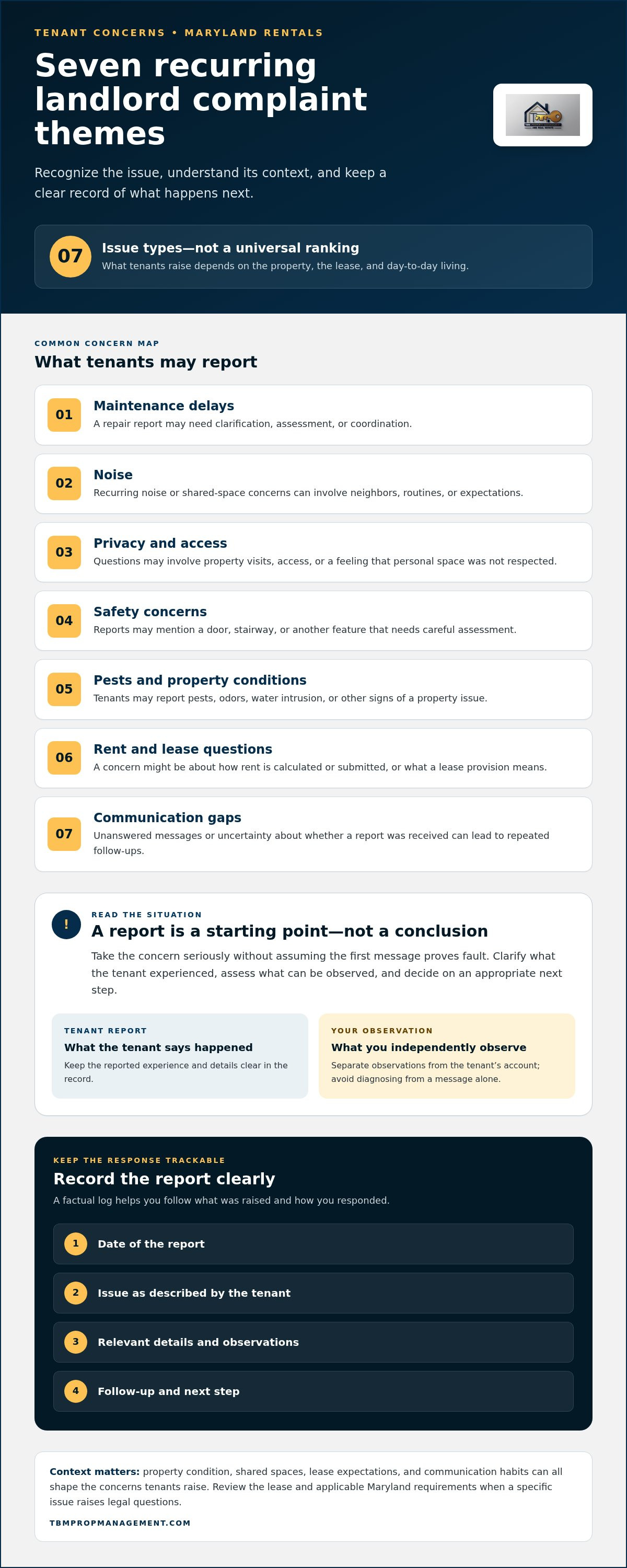
There’s no universal ranking of tenant complaints. The concerns owners hear depend on the property, the lease, and the day-to-day experience of living there. If you’re wondering what are the top landlord complaints, recurring categories include maintenance delays, noise, privacy, safety, pests, rent questions, and communication gaps. Treat these as patterns to recognize, not a scoreboard for deciding whose concern matters most.
Clear expectations can prevent some misunderstandings. Tenants benefit from knowing how to report an issue, what details to include, and how updates will be shared. Owners benefit from explaining responsibilities and communication practices plainly, then following through consistently. If a tenant doesn’t know whether a repair request was received, they may send repeated messages. A brief acknowledgment and an update about the next step can reduce that uncertainty.
A landlord complaint is a tenant-raised concern that calls for a recorded response, whether that response is an investigation, an explanation, or a next step. Listening doesn’t require deciding immediately that a concern is either justified or unfounded. Rights and responsibilities can vary with the circumstances and applicable rules. The broad topic of landlord-tenant law provides useful context, but it isn’t a substitute for reviewing Maryland requirements when a specific issue raises legal questions.
What makes a tenant concern a landlord complaint?
A general comment might be feedback about a feature of the home, while a question might ask how rent is submitted. A request for action is different: for example, a tenant reports a leak, recurring noise, or a pest concern and asks for a response. Record the date, the issue as described, relevant details, and any follow-up. That history helps you track what was reported and how you responded.
Keep the record factual. Note what the tenant says separately from what you observe, and avoid treating a first message as proof of fault. The report may need clarification, assessment, or a practical response. Taking it seriously means creating a clear path to understand the concern, not making assumptions before you have the details.
Why complaint patterns vary between rental properties
Property condition, shared spaces, lease expectations, and communication habits all shape what tenants raise. In an apartment building, a concern might involve noise through shared walls or upkeep of common areas. A condo may bring questions about building access or shared facilities, while a single-family home may prompt reports about pests, exterior conditions, or individual systems.
Even similar homes can generate different concerns if tenants have different expectations or aren’t sure how to report a problem. Look for repeated themes in your own records rather than assuming a national or local ranking applies to your property. A consistent log can reveal where expectations need clarification, communication is falling short, or a recurring issue deserves closer attention.
The Most Common Landlord Complaints: Repairs, Noise, Privacy, and More
What are the top landlord complaints? The useful answer is a set of recurring issue types, not a ranking that applies to every rental. A dripping faucet, loud late-night activity, a question about rent, and an unanswered message are different concerns, and each needs to be understood in context. Some details are directly observable; others describe a tenant’s experience or perception. Both can help you identify what needs clarification or assessment.
Group reports by subject instead of treating every message as the same kind of problem. This makes it easier to see whether a concern involves the property’s condition, shared living, lease expectations, or communication. Survey percentages shouldn’t be treated as a definitive ranking for Maryland rentals unless the survey’s context and methodology support that conclusion.
Property condition and shared-living concerns
Reports about property condition may involve a delayed repair, signs of pests, unpleasant odors, water intrusion, or a concern about a door, stairway, or another feature. Record what the tenant observed without trying to diagnose the cause from a message alone. A concern about noise or a shared space may involve neighboring households, building routines, or unclear expectations. Distinguish the reported impact from what can be independently observed.
Safety-related reports deserve careful attention and prompt assessment. That doesn’t mean making a technical conclusion before the facts are clear. Ask for specific details, such as where the issue occurred and what the tenant noticed, then determine an appropriate next step. For recurring maintenance concerns, a clear way to receive and track reports can help prevent messages from getting lost without turning every report into a repair diagnosis.
Lease, privacy, rent, and communication concerns
Some complaints arise from uncertainty about lease terms or routine arrangements. A tenant may ask how rent is calculated or submitted, what a lease provision means, or how a property-related visit will be communicated. Privacy concerns can involve access or a feeling that personal space hasn’t been respected. Keep the specific question distinct from your interpretation, and review the lease and applicable Maryland requirements before relying on an assumption.
Unanswered messages are another recurring concern. A tenant may follow up because they’re unsure whether a report reached the right person. That alone doesn’t prove misconduct, but it can signal that the communication process needs clarification. Acknowledging receipt and giving a realistic next update can reduce uncertainty. For more local legal context, review this Maryland landlord-tenant rights guide.
If complaints keep circling back to missed messages, rent questions, or maintenance coordination, more consistent oversight can help organize the work. TBM Property Management supports residential owners in Anne Arundel, Prince George’s, Montgomery, and Howard counties with full-service property management, including rent collection, inspections, and maintenance coordination. Explore TBM Property Management Service and get 1st Month FREE on Property Management Service.
How Landlords Can Decide Which Complaints Need Attention First
When several concerns arrive close together, use a consistent process rather than relying on whichever message feels most pressing. A report involving possible danger may call for prompt assessment, while a question about a lease term may need careful review and a clear reply. Urgency depends on the reported condition, its impact, and reliable follow-up. This helps you stay attentive without making a legal or technical determination before you have enough information.
A simple five-step complaint triage
Use the same sequence for each report so details and follow-up don’t get lost. This process helps you gather facts, identify a sensible next step, and keep the tenant informed.
- Acknowledge receipt. Let the tenant know you received the concern. If the message is unclear, ask concise questions, such as where the issue is occurring, when it began, and whether it has changed.
- Clarify the impact. Ask what the tenant has observed and how the issue affects use of the home or shared space. Separate their description from conclusions about the cause.
- Record the report. Note the date, reported condition, relevant communications, and any available observations. Add follow-up actions as they happen, keeping the record factual and organized.
- Assess the next step. Consider whether the report describes a possible safety concern, an ongoing inconvenience, or a request for information. If a specialist assessment is appropriate, arrange that follow-up rather than guessing at the cause.
- Update and follow through. Tell the tenant what will happen next and when you’ll communicate again. If plans change, provide an update instead of leaving the tenant to wonder whether the concern is still being addressed.
This approach also helps answer the question, “what are the top landlord complaints?” The category alone doesn’t determine priority. A maintenance report needs context about what was observed and its impact. A rent or lease question may be less time-sensitive, but a prompt acknowledgment can still prevent confusion from growing.
When a complaint may need legal or specialist attention
Take extra care with reports involving safety, discrimination, property access, or unresolved questions about rights and responsibilities. Preserve relevant communications, review the lease terms, and avoid making a legal conclusion based only on a brief report. Documentation creates a useful history, but it doesn’t replace legal advice when the circumstances call for it. Likewise, a landlord’s initial impression isn’t a substitute for a qualified technical assessment.
For Maryland-specific questions, check current authoritative guidance before relying on a legal interpretation or deadline. Broader processes can also help landlords keep records and responsibilities organized; this full-service property management guide explains how ongoing oversight fits into day-to-day ownership.
How to Respond to Tenant Complaints Without Escalation
A tenant’s concern can feel frustrating, especially if you see the situation differently. Still, a measured reply keeps the conversation focused on what was reported and what happens next. You can acknowledge the tenant’s experience without agreeing to facts you haven’t verified or dismissing the concern before you understand it.
A calm response landlords can adapt
Keep your first reply brief, neutral, and specific. For example: “Thanks for letting me know about the water near the kitchen sink. I’ve received your report and will review the details. Could you tell me when you first noticed it and whether it’s getting worse? I’ll update you by [time or date] about the next step.”
This acknowledgment confirms receipt, restates the concern, asks focused questions, and sets an expectation for communication. It doesn’t promise a particular repair outcome or completion date before the issue has been assessed. If the tenant’s message is emotional, respond to the practical concern rather than matching the tone. Avoid blame, speculation, or dismissive language such as “It’s probably nothing.”
For reports that need maintenance coordination, keep the tenant informed as details develop. The Maryland rental maintenance guide offers more context on keeping maintenance processes organized.
Close the loop and watch for recurring complaints
A response isn’t complete just because you’ve sent an acknowledgment. Tell the tenant when they can expect another update, then follow through even if your next message is simply to explain that you’re still arranging the next step. If plans change, share the updated information instead of allowing silence to create more uncertainty.
Once an issue has been addressed or assessed, record what happened and communicate the outcome in plain language. If more work remains, explain the next step without blaming the tenant or suggesting the concern was unimportant. A consistent record of reports, replies, and actions can help you spot patterns, such as repeated concerns about one area of the property or recurring confusion about how to submit a request.
Reviewing those patterns can reveal where expectations or communication need attention. If tenants repeatedly ask whether a report was received, for instance, the response process may need a clearer acknowledgment and follow-up routine. If similar concerns return, compare the reports and actions taken rather than treating each message as an isolated event. That record supports continuity and helps you give tenants a grounded update.
Knowing what are the top landlord complaints is only the first step; a steady response process helps owners manage concerns constructively. For residential owners in Anne Arundel, Prince George’s, Montgomery, and Howard counties, explore full-service property management to support tenant communication, rent collection, and maintenance coordination. Get 1st Month FREE on Property Management Service.
When a Maryland Landlord May Benefit from Ongoing Management Support
Recurring tenant complaints don’t automatically mean a landlord has failed. They can, however, point to a need for more consistent oversight, especially when the same concerns return, messages go unanswered, or follow-up slips between other responsibilities. If you’ve been asking what are the top landlord complaints, consider whether your own records show a pattern, not just a string of unrelated requests. A steady process for rent collection, inspections, and maintenance coordination can help keep routine responsibilities organized and give you clearer context for responding.
What ongoing management can help organize
TBM Property Management provides rent collection, property inspections, and maintenance coordination, services that connect directly to common landlord concerns. Organized rent collection can help clarify payment records and tenant questions. Inspections can provide information about property condition, while maintenance coordination helps owners track reported issues and next steps. These processes support oversight, but they aren’t a promise that complaints will stop or that every concern will have the same solution.
For owners preparing to rent a home, TBM’s tenant placement and leasing services include tenant screening and lease preparation. Clear expectations established at the start can give tenants and owners a shared reference point during the tenancy. To weigh how these responsibilities fit together, review this guide to choosing professional property management in Maryland.
A local next step for Maryland rental owners
Whether ongoing management makes sense depends on your property, available time, and the consistency of your current process. Consider it if keeping up with tenant communication, maintenance reports, inspections, and rent collection has become difficult alongside other responsibilities. It may also help when recurring complaints make it harder to see which issues are new and which need continued follow-up.
TBM Property Management serves residential landlords and investors in Anne Arundel, Prince George’s, Montgomery, and Howard counties in Maryland. Owner/operator Tanika Belfield-Martin is a licensed associate broker with over 13 years of real-estate experience. TBM provides property management, leasing, and tenant placement services, with plans designed for different levels of support.
Tenant Placement & Leasing Only costs 1st Month’s Rent. Full Service is 7 %-9 % of monthly rent, with a minimum of $99 per month, and includes tenant placement functions, rent collection, monthly owner statements, semi-annual inspections, and maintenance coordination. Full Management (Premium Service) is 9 %-11 % of monthly rent, with a minimum of $150 per month, and includes everything in Full Service plus eviction coordination/handling. Get 1st Month FREE on Property Management Service. Explore TBM’s property management services to choose the level of support that fits your rental.
Make Your Next Tenant Response More Intentional
Turn a good response into a dependable habit. Choose a simple way to track concerns, note who is responsible for follow-up, and review recurring issues before they become familiar frustrations. That gives you a clearer picture of where your process is working and where a small adjustment could make communication easier for everyone.
Knowing what are the top landlord complaints is useful, but the way you handle the next report matters more. You don’t have to solve every challenge at once. Start by making your response process consistent, then consider whether ongoing support could free you to focus on other priorities. Tanika Belfield-Martin, owner/operator of TBM Property Management, brings over 13 years of licensed real-estate experience. Get 1st Month FREE on Property Management Service.
Explore property management support for Maryland landlords and take a thoughtful next step toward a more organized rental experience. With a clear process and the right support, you can approach tenant concerns with greater confidence.
Frequently Asked Questions
What are the most common complaints landlords receive from tenants?
Common complaints involve repairs, noise, privacy, pests, safety, rent questions, and communication. The mix depends on the rental and the tenant’s experience, so it’s more useful to recognize patterns than to treat any list as a fixed ranking. For example, if several messages refer to the same shared hallway, that may call for a different review than separate questions about rent records. Treat each report on its own details.
Which tenant complaints should a landlord address first?
Prioritize based on the condition described, its possible impact on people or the property, and what you know so far. A report that suggests immediate risk deserves prompt assessment; a question about how a payment was recorded can usually be reviewed through the relevant records. Acknowledge both, keep notes, and tell the tenant what you’ll do next. For legal questions, consult current Maryland guidance or appropriate legal counsel.
How should a landlord respond to a tenant complaint?
Begin with a respectful acknowledgment, then ask for details that will help you understand the concern. For instance, if a tenant says a common area is noisy, ask when it tends to happen and which area is affected. Keep your reply factual, avoid assigning blame, and don’t promise a result before you know what action is appropriate. A clear, measured response can help keep the conversation focused.
Can a tenant complain about noise from another tenant?
Yes. A tenant can raise a concern about noise from another resident, particularly where homes share walls or common areas. Ask for specific information, such as the location, times, and how often it occurs, then review the relevant lease terms and property procedures. Avoid naming or blaming another resident before you understand the report. If the concern raises a legal question, verify current requirements before deciding how to proceed.
What should a landlord do if the same complaint keeps coming back?
Compare the repeated reports with your notes to see whether the issue, location, or circumstances are similar. Check whether a prior action was completed and whether the tenant received an update. A recurring concern might point to an unresolved condition, mismatched expectations, or a communication gap, but don’t assume which explanation applies. Choose a next step based on the record, and seek current legal guidance if rights or compliance are involved.
Are landlord complaint rules different in Maryland counties?
Rules that apply can depend on the subject and the property’s jurisdiction, so don’t assume one general checklist answers every question. For a complaint about access, lease terms, or another rights-related matter, identify the precise issue and check current, authoritative guidance for that location. If the answer remains unclear or the stakes are significant, consult a qualified Maryland attorney. Keep a note of the guidance you relied on and the decision made.
Can a property manager handle tenant complaints for a landlord?
A property manager can handle operational responsibilities included in the service arrangement, such as tenant relations, rent collection, maintenance coordination, and inspections. For example, a manager may help keep a maintenance report and its follow-up organized while the owner stays informed. Management support can establish a steadier process, but it can’t guarantee complaints will stop or resolve every dispute. Owners should understand how responsibilities are divided before management begins.