Understanding Landlord Tenant Court in PG County: Rent and Notices
Understanding landlord-tenant court in Prince George’s County starts with an important distinction: a notice to vacate is not an eviction. A landlord must file a court complaint, obtain a judgment for possession, and secure a warrant of restitution before a tenant can be evicted. The notice and lease help explain the dispute, while the court process determines what happens next.
Receiving a notice can feel alarming, especially when rent, a lease term, or a security deposit is disputed. This guide explains what a notice to vacate may mean, how lease terms and deposits can affect a case, and why a landlord might ask the court for a monetary judgment as well as possession. You’ll also learn how Maryland landlord-tenant rights and responsibilities shape the process in Prince George’s County, and how a demand to leave differs from a court order.
Key Takeaways
- A notice to vacate is not itself an eviction; understand how lease terms and court proceedings affect what may happen next.
- Rent court may address possession and unpaid rent, while the rules for requesting a monetary judgment can depend on how the tenant was served.
- Security deposit limits, condition records, and return deadlines can all matter when a tenancy ends or a dispute arises.
- Learn how TBM Property Management’s leasing, rent collection, and full-service management can help landlords handle ongoing rental responsibilities.
Why Ask For A Monetary Judgment In Rent Court?
A failure-to-pay-rent complaint under Real Prop. 8-401 alleges unpaid rent and seeks possession. A landlord may also request a monetary judgment for rent, which can support later collection actions, including wage garnishment or bank-account levies. The court may grant possession yet deny a money award. Understanding landlord-tenant court in PG County means recognizing these are separate requests.
Personal service matters when a landlord seeks a monetary judgment in rent court. Service by posting supports a request for possession only. Landlords may use a private process server to personally serve a tenant. Rent court claims are limited to rent; a separate civil suit may allow claims for other damages.
At a hearing, both sides present records and explain the dispute. Tenants can raise issues such as payment records, lease terms, or disputed charges. For monthly rent, a late fee cannot be charged until the sixth day of the rent period. A written lease cannot impose a penalty above 5% of rent due.
Prince George’s County’s covered-unit rent increase limit is the lesser of CPI-U plus 3 percent or 6 percent annually. For age-restricted senior housing, the limit is the lesser of CPI-U or 4.5 percent. The annual allowance takes effect July 1 each year; units completed on or after January 1, 2000, are exempt.
Maryland tenants appealing a nonpayment eviction case must file within 4 days, according to the Maryland General Assembly. Prince George’s County District Court hears failure-to-pay-rent, rent-escrow, breach-of-lease, tenant-holding-over, and wrongful-detainer cases. Filing fees and court costs depend on case type and requested relief. Understanding landlord-tenant court in PG County also means knowing what to expect at the hearing.
For unsafe housing, notify the landlord about serious defects and allow reasonable repair time before seeking rent escrow under Real Prop. 8-211. More than 30 days is presumed unreasonable for repairs, although the presumption can be rebutted, according to the Maryland General Assembly. Bring repair records and lease documents to support your account.
Lease requirements and termination notices
A notice to vacate signals that an owner wants to end the tenancy; it is not an eviction order. In Prince George’s County, the lease term and notice type help determine whether a landlord can file a tenant-holding-over complaint. Keep the agreement, rent records, and written notices together, as they establish the terms and timeline behind the dispute.
For a Maryland written lease longer than one week or a month-to-month (monthly) tenancy, a landlord must give 60 days’ notice before filing a tenant-holding-over complaint, according to the Maryland General Assembly. Other tenancy types have different notice periods:
- A year-to-year lease requires 90 days’ notice.
- A written week-to-week lease requires 7 days’ notice.
- Notice requirements can vary depending on the tenancy and lease terms.
These timelines concern ending a tenancy and filing a holding-over complaint. A breach-of-lease case addresses an alleged violation during the tenancy. Maryland generally requires 30 days’ written notice of a lease violation before filing. If the tenant’s behavior poses an imminent threat of danger, the notice period is 14 days. The complaint is identified under Real Prop. 8-402.1.
Lease format matters, too. Maryland permits oral leases for terms under one year, but landlords with five or more rental units must provide written leases. Written leases are also required for tenancies of one year or longer. A written agreement can make the lease term, rent, and specific obligations easier to establish in court.
Some lease penalties have limits. In Prince George’s County, a written lease may not impose a late-rent penalty exceeding 5% of rent due. A clause above that cap can become an issue in a dispute. For landlords, consistent tenant screening practices can help set clear expectations before an agreement begins.
Security deposit limits and returns
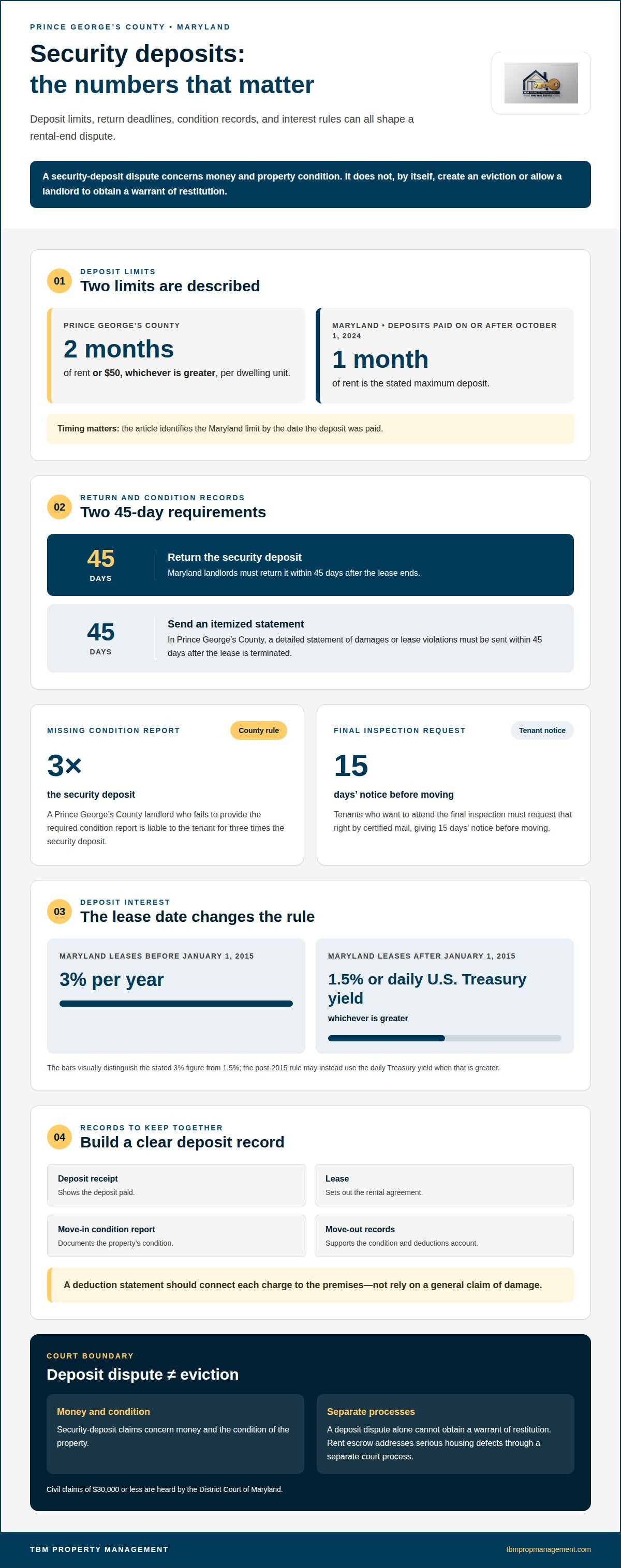
A security deposit can become a central issue when a Prince George’s County rental ends. The county limit is two months’ rent or $50, whichever is greater, per dwelling unit. Maryland’s limit for deposits paid on or after October 1, 2024, is no more than one month’s rent. The date the deposit was paid therefore matters when identifying the applicable limit.
Keep the deposit receipt, lease, move-in condition report, and move-out records together. Maryland landlords must return security deposits within 45 days after the lease ends. In Prince George’s County, a landlord must send a detailed statement of damages or lease violations within 45 days after the lease is terminated. A clear statement connects each deduction to the premises rather than relying on a general claim of damage.
Condition documentation can affect the dispute. A Prince George’s County landlord who fails to provide the required condition report is liable to the tenant for three times the security deposit. Tenants who want to attend a final inspection must request that right by certified mail, giving 15 days’ notice before moving. Keep a copy of the request and any response with the rental records.
Interest rules also depend on timing. For Maryland leases before January 1, 2015, the security-deposit interest rate is 3% per year. For leases after January 1, 2015, interest is 1.5% or the daily U.S. Treasury yield rate, whichever is greater. A deposit dispute may be filed as a civil claim; the District Court of Maryland hears civil cases involving amounts of $30,000 or less.
Security-deposit claims concern money and the condition of the property, not automatic eviction. A landlord cannot use a deposit dispute alone to obtain a warrant of restitution. If an unpaid balance becomes a separate judgment, collection can involve employment income. Rent escrow addresses serious housing defects through a separate court process; it does not replace documentation of deposit deductions.
Maryland landlord-tenant rights and responsibilities
Maryland law sets duties for owners and protections for renters. The rules appear in Real Property Title 8, sections 8-101 through 8-812. A landlord cannot evict a tenant without filing a court complaint, obtaining a judgment for possession, and securing a warrant of restitution. A notice alone does not complete those court steps.
For rental homes located in Prince George’s County, local rules also apply. County Code Subtitle 13, Division 3, sections 13-135 through 13-180, covers county landlord-tenant regulations. A landlord generally must give 24 hours’ notice before entering a unit, except for an emergency affecting health, safety, or welfare. That notice gives tenants a clear opportunity to prepare.
Inspection records can help identify responsibility for defects. A tenant may request a rental-unit condition report within 15 days after occupancy begins. If a tenant finds a defect the landlord may not know about, they must report it within 48 hours, or immediately if it could cause serious harm to a person or property. Keep dated messages and photographs with the lease.
Maryland rent escrow gives tenants a court process for serious housing defects. Tenants must notify the landlord and allow reasonable repair time before placing rent in escrow under Real Prop. 8-211. In Maryland rent-escrow cases, more than 30 days is presumed unreasonable for a landlord to take to repair defects, although the presumption can be rebutted, according to the Maryland General Assembly. Rodent infestation qualifies when it affects two or more dwelling units.
Older homes have additional lead-safety responsibilities. Maryland landlords must register and inspect rental properties built before 1978 for lead paint, with an inspection required at each change in tenancy. If lead hazards are found, required risk reduction must occur within 30 days after notice. For rental owners seeking more consistent property records, review your property oversight options.
TBM Property Management: Full-Service Property Management
TBM Property Management helps Prince George’s County rental owners manage the responsibilities that can lead to disputes. Its Full-Service Property Management brings leasing, tenant placement, and rent collection together, helping owners keep rental operations organized. If you’re preparing to rent a property, tenant placement and leasing services can support the process of finding a renter and setting up the tenancy. If rent tracking and ongoing oversight are taking too much time, full-service management may be a practical fit. Property management does not replace legal representation in a court case, but consistent rental records can help owners keep tenancy details accessible. For support with ongoing rental management, contact TBM Property Management.
Build a More Manageable Rental Plan
A clearer understanding of landlord-tenant court in PG County can help rental owners make informed decisions before a tenancy becomes a dispute. Build consistent processes for each tenancy: set out lease terms, record rent payments, and keep property matters organized. These routines can make rental oversight more manageable and less reactive.
TBM Property Management provides Full-Service Property Management, Tenant Placement, and Leasing Services for owners who want support with these ongoing responsibilities. If managing a rental is difficult to balance with other priorities, professional support can add structure to the work, while legal advice remains important for a court case.
Contact TBM Property Management to discuss support for your rental property. A more organized approach can help you move forward with greater clarity and confidence.
Frequently Asked Questions
What if you receive a notice to vacate from your landlord?
Read the notice carefully and keep a copy, including its delivery date and any stated move-out date. Compare the reason with your lease, then collect related messages, rent receipts, or repair records. If you believe the notice is mistaken, respond in writing and keep a copy. A notice alone does not show what evidence a court may consider if a complaint follows.
What should you do if you receive a court summons?
Read the summons and complaint together, noting the hearing date, location, and the landlord’s claims. Gather relevant documents, such as payment records, your lease, and written communications. Plan to attend the hearing and explain clearly which facts you agree with and which you dispute. If you need legal assistance, seek it promptly so you can prepare before the court date.
Where is the landlord-tenant court in Prince George’s County, Maryland?
Landlord-tenant cases are heard at the District Court of Maryland for Prince George’s County in Hyattsville, at 4990 Rhode Island Avenue, Hyattsville, Maryland 20781-2008. The courthouse is open from 8:30 AM to 4:30 PM Monday through Friday, except legal holidays. Bring your summons and identification, and allow time to locate the courtroom listed for your case.
How does the eviction process work in Prince George’s County, Maryland?
A landlord begins an eviction case by filing a complaint in court. The tenant receives notice of the case and a hearing, where both sides can present relevant information. If the court grants possession, further legal steps are still required, including a warrant of restitution. In a nonpayment case, a tenant may redeem the property before eviction by paying the rent owed as determined by the court.
How can a tenant respond to an eviction case or court summons in Prince George’s County?
Use the complaint to identify the landlord’s specific claims, then organize records that address each one. If rent payment is disputed, for example, bring receipts or account statements; if repairs are relevant, bring dated messages and photographs. Attend the hearing and explain your position directly. Keep copies of documents you submit, the summons, and any court papers you receive afterward.
What notices must a landlord give before filing for eviction in Maryland?
The required notice depends on the reason for filing and the tenancy agreement. For a lease violation, Maryland generally requires written notice giving the tenant 30 days before a breach-of-lease case; the period is 14 days when the tenant’s behavior poses an imminent threat of danger. Ending a tenancy and seeking possession involves different notice periods, which vary by lease type.