
What Happens If a Tenant Pays Rent Late Every Month?
Rent may be considered late the day after the due date in the lease, even when a grace period delays a late fee. If you’re wondering what happens if a tenant pays rent late every month, repeated delays can lead to fees or formal notices and may put the tenancy at risk, depending on the lease and local law.
It’s understandable to feel concerned when a payment is late again, especially if you’re unsure whether a grace period applies or what may happen next. The due date, lease terms, and local rules all matter, so one late payment does not tell the whole story.
This article explains how to find the rent due date and any grace period, what repeated late payments may mean, and how to discuss a payment problem. Clear, respectful communication and written records can help make expectations easier to understand.
Key Takeaways
- Compare the lease’s rent due date with any grace-period terms to understand when payment is treated as late.
- Repeated delays can lead to fees or formal notices, so keep track of payment dates and landlord communications.
- Tell your landlord early if you expect a delay, and put any agreed payment arrangement in writing.
- Late-fee rules depend on the lease and local law, so understand the terms that apply to your rental.
When Is Rent Considered Late?
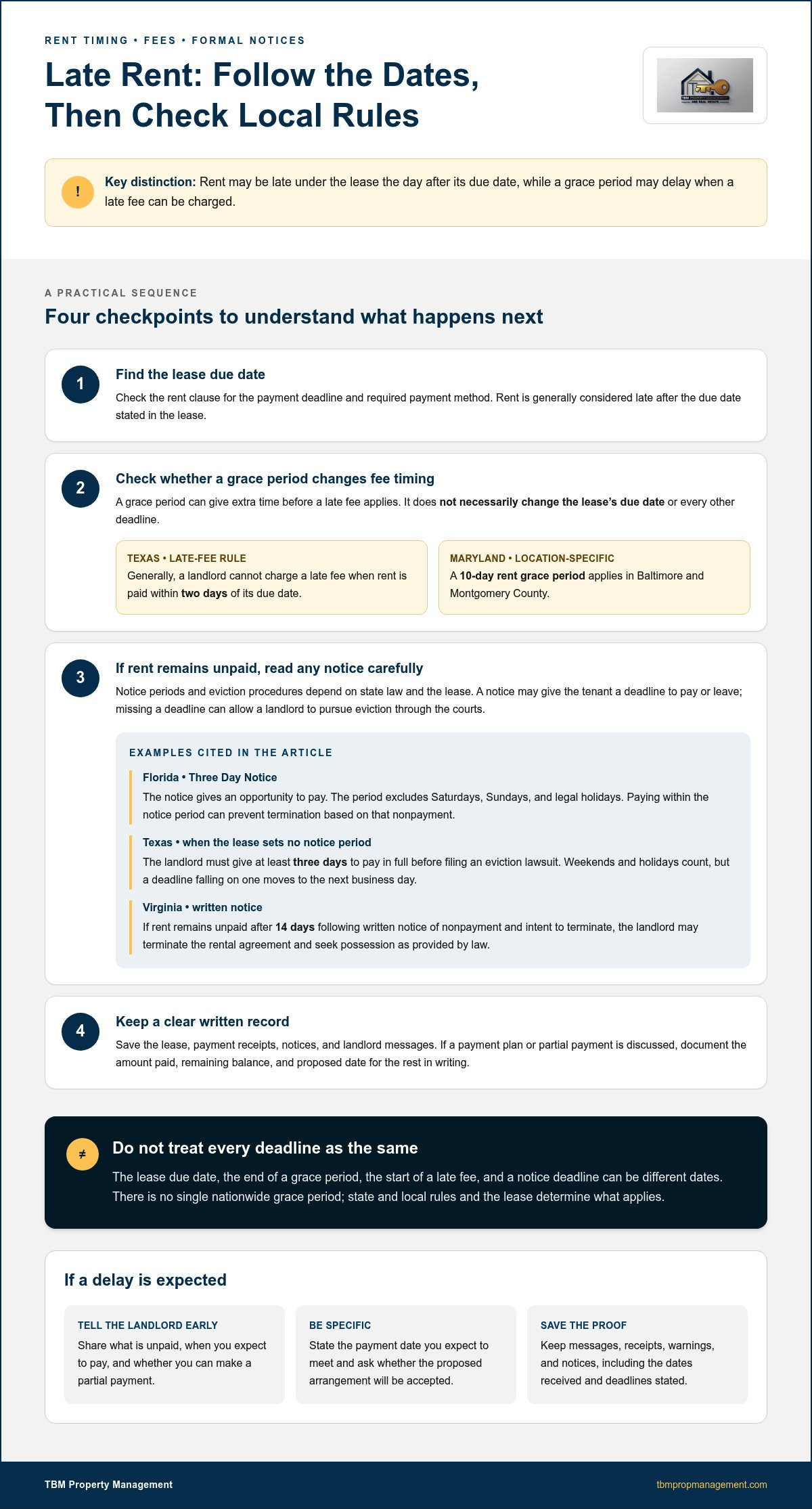
Rent is generally late after the due date in the lease, but notice and eviction procedures depend on state law. A landlord may serve a notice to pay rent or vacate if rent remains unpaid. Repeated late payments can prompt formal action, even if earlier payments were eventually made. Whether a landlord can act also depends on whether rent is still owed and what the lease says.
Can a landlord serve a pay-or-quit notice for repeatedly late rent? Yes, if rent remains unpaid, a landlord can give the required notice and state the deadline to pay or leave. In Florida, a Three Day Notice gives a tenant an opportunity to pay. The landlord cannot terminate the tenancy for nonpayment before the notice expires, and the period excludes Saturdays, Sundays, and legal holidays. Paying within the notice period can prevent termination based on that nonpayment.
Missing the deadline can allow the landlord to pursue eviction through the courts. In Texas, when the lease agreement doesn’t set a notice period, a landlord must give at least three days to pay in full before filing an eviction lawsuit. The notice period includes weekends and holidays, but a deadline falling on either moves to the next business day. In Virginia, according to the Virginia General Assembly, a landlord may terminate the rental agreement if rent remains unpaid after 14 days following written notice of nonpayment and intent to terminate, then seek possession as provided in § 55.1-1251.
What legal protections or defenses apply to tenants facing eviction for late rent? The required notice period gives tenants a chance to pay, while local rules govern how an eviction proceeds. The Virginia Residential Landlord and Tenant Act (VRLTA) protects tenants from self-help tactics such as changing locks or shutting off utilities. Landlords must complete the court process before taking those steps.
Keep every warning, notice, payment receipt, and landlord message. A dated record can help show whether payment was made before the deadline or whether a notice misstated the balance. In Florida, repeatedly accepting rent after a Three Day Notice expires may support a tenant’s argument that the landlord waived the lease’s due date. A written warning that future late rent won’t be accepted may help address that defense, but does not guarantee the outcome.
Confirming the rent due date and any grace period
Is there a grace period for rent payments in the United States? There’s no single nationwide period. State and local rules, along with the lease, determine the deadline. Rent is technically late the day after the lease’s due date, although a grace period may affect when late fees apply.
Grace Periods Before Late Fees
A grace period gives a tenant extra time before a late fee can be charged, but it doesn’t necessarily change the lease’s due date. Paying during the grace period may avoid a fee even though the payment is still late under the lease. In Texas, a landlord generally cannot charge a late fee when rent is paid within two days of its due date. Treat this as a late-fee protection, not a universal extension of every rental deadline.
Check the lease for the due date, payment method, and late-fee clause. If rent is due on the first and the lease provides a grace period, identify its final day and whether it affects fees or other consequences. Keep a copy of the lease and payment receipt to clarify the situation if a charge appears.
State and Local Grace-Period Rules
State and local rules set different grace periods, so tenants’ rights depend on the rental’s location. Grace-period rules vary by location, so check the requirements that apply to your rental. Grace-period rules may differ for some tenants depending on their circumstances. These differences make it risky to assume another state’s rule applies to your home.
In Baltimore and Montgomery County, Maryland, a 10-day rent grace period applies, according to the Maryland General Assembly. Check the location-specific rule alongside your lease, since the lease may set the payment date while law governs late-fee timing. State laws also vary in how they restrict late charges; California, for example, has specific laws restricting late fees.
To confirm the applicable terms, locate the rent clause and any late-fee provision in your lease, then compare them with the rule for your city and state. Note the due date, the end of any grace period, and when a charge may begin. If a notice and your records show different dates, preserve the notice and proof of payment so you can explain the discrepancy clearly.
Communicating with a landlord about late rent
If you expect a rent payment to arrive late, contact your landlord before the due date. A short written message can explain what is unpaid, when you expect to pay, and whether you can make a partial payment. State the expected payment date and ask whether the landlord will accept the arrangement. Specific details help both sides understand the proposed plan and its limits.
Keep the conversation factual and save each email, text, receipt, and reply. If the landlord sends a warning, note the date received and the deadline stated. A landlord addressing chronic late payments should send a written warning at least 30 days before the next monthly rent payment is due. Written records also help clarify whether an agreed plan changed the original payment expectation.
Before accepting partial rent, landlords and tenants should document the arrangement in writing. Record the amount paid, the remaining balance, and the proposed date for paying the rest. This avoids relying on a verbal discussion while the account remains unpaid. Accepting partial rent may affect earlier legal action or restart an eviction process, so document the terms before treating a partial payment as a solution.
- Tenant: State the reason for the delay briefly, name the payment date you can meet, and keep proof of payment.
- Landlord: Record rent reminders, notices, and how often late payments occur, then communicate the balance and deadline clearly.
- Both: Put any changed payment arrangement in writing and keep a copy with the lease agreement.
If late rent has become a recurring pattern, discuss the cause rather than making promises you can’t keep. A landlord can explain what remains due and the consequences under the lease, while a tenant can propose a realistic schedule or discuss a longer-term arrangement. Respond promptly to each notice. Silence can leave a deadline unclear and make the situation harder to resolve.
How much can a landlord charge for late rent in each state?
There’s no single late-fee limit that applies across every state. The amount can depend on state or local law, the lease, and whether rent is partly or fully unpaid. More than a dozen states have laws governing late fees, so a charge allowed in one location may exceed the limit in another. Check the rules that apply to the rental and compare the fee with the lease before paying.
Virginia law limits a landlord's late rent fee to no more than 10% of the monthly rent or unpaid balance for a partial rent payment, whichever is less, according to Virginia General Assembly. In New York City, late rent fees are capped at the lesser of 5% of past-due rent or $50, according to New York State Legislature. These examples show why location and the balance owed matter when assessing a charge.
Texas uses different standards. A landlord generally can’t charge a late fee when rent is paid within two days of its due date. For larger apartment complexes, a fee is generally considered reasonable at no more than 10% of a month’s rent. For smaller properties, the general reasonable limit is no more than 12% of a month’s rent. These standards don’t establish one nationwide formula.
To review a fee, compare the lease’s late-fee clause with the local rule. Confirm the rent amount, unpaid balance, date payment was received, and how the lease calculates the charge. A fee based on the full rent may be treated differently from one based on a partial-payment balance. Keep the notice, payment receipt, and your calculation together. If the charge differs from the lease or applicable limit, raise the specific discrepancy in writing and include your records.
Clear, consistent rent collection practices help property owners track payments and apply lease terms carefully. For tenants, asking for an itemized explanation can clarify how a charge was calculated. The governing state and local rules remain central, so compare like with like: same rental location, same balance, and same fee basis.
TBM Property Management: Full-Service Property Management
TBM Property Management helps property owners manage the ongoing work involved in rent collection and leasing. If late payments are taking time away from other responsibilities, Full-Service Property Management brings ongoing oversight together with rent collection, monthly owner statements, semi-annual inspections, and maintenance coordination. Leasing services help establish the rental terms tenants are expected to follow.
For owners preparing to fill a vacancy, TBM Property Management offers Tenant Placement and tenant screening, including credit checks, background checks, and employment verification. These services support leasing and tenant selection; they don’t replace the need to follow applicable notice and eviction requirements when rent goes unpaid. A consistent management process can help organize routine tasks while keeping payment records and lease responsibilities in view.
Contact TBM Property Management to discuss property management support for your rental.
Build a More Consistent Rental Routine
Repeated delays are easier to address when rent expectations, communication, and follow-up form a consistent routine. If you own a rental, decide how you’ll record payments, respond to missed deadlines, and document tenant conversations. A steady process can help you focus on the property’s long-term needs instead of treating each late payment as a separate surprise.
Knowing what happens if a tenant pays rent late every month can help you set clearer expectations, but the next step is choosing a management approach you can sustain. TBM Property Management offers Full-Service Property Management, Tenant Placement, and Leasing Services for property owners seeking support with ongoing rental responsibilities. The current Property Management Service offer includes the first month free.
For a practical conversation about managing your rental, contact TBM Property Management. A thoughtful next step can help you move forward with greater clarity and confidence.
Frequently Asked Questions
Can a Landlord Sue a Tenant for Unpaid Rent?
Yes, a landlord may sue to recover unpaid rent, subject to the lease and applicable law. Understanding what happens if a tenant pays rent late every month can help tenants see why payment records matter, but whether a lawsuit is filed depends on the unpaid balance and the circumstances. Keep receipts, account statements, and written agreements together so you can explain any disagreement about what remains due.
Do you get a late fee notice?
Not necessarily. A landlord may send a late-rent notice, but the law may not require one in every situation. The lease may explain when a fee applies and how it is calculated. If a charge appears, compare the payment date and amount with your records, then request a written breakdown if the calculation is unclear.
Is a Resident Allowed To Pay Late?
A resident can make a late payment, but paying late doesn’t automatically prevent eviction. Texas has a limited opportunity to make up late rent once each lease term. It applies only when this is the first late month in that term and only one month’s rent is overdue. For evictions filed after January 1, 2026, check whether those conditions fit your situation.
What Is a Pay or Quit Notice?
A pay-or-quit notice is a formal demand that a tenant pay overdue rent or leave by a stated deadline. It identifies the nonpayment and gives the tenant a chance to respond before the landlord pursues eviction. Read the notice promptly, compare its balance with your receipts, and keep a copy. The deadline and required wording vary by state.
What does a lease say about recurring late rent payments?
Understanding what happens if a tenant pays rent late every month also means reviewing how the lease addresses repeated delays. It may set payment expectations and describe the consequences of noncompliance. Recurring lateness or an eviction judgment can affect rental history and future applications. Review renewal terms too, since a landlord may decide not to renew at the end of a lease term, subject to applicable law.
How many days' notice is required before eviction for late rent in each state?
There isn’t one notice period for every state. Florida requires a Three Day Notice for nonpayment, excluding Saturdays, Sundays, and legal holidays. In Texas, if the lease sets no notice period, the landlord must allow at least three days to pay before filing; weekends and holidays count, with the deadline moving to the next business day when needed. Virginia requires written notice allowing 14 days to pay.