
What to Include in a Maryland Rental Agreement: The 2026 Landlord Guide
Did you know that a single missing disclosure in your lease could potentially cost you thousands in legal fees or invalidate an eviction warrant when you need it most? It's completely normal to feel a sense of anxiety when you're trying to keep up with shifting regulations like the Renters' Rights and Stabilization Act. You likely want the peace of mind that comes with a secure property, yet the constant evolution of state and county laws can leave even the most seasoned landlord feeling overwhelmed. We understand the pressure of protecting your assets while maintaining a positive relationship with your tenants.
Learning exactly what to include in a maryland rental agreement is the first step toward reclaiming your time and reducing your legal exposure. Whether you're managing properties in Baltimore City or Montgomery County, your lease must be a precise, localized risk-management tool. This guide provides a clear roadmap through the 2026 legal landscape. You'll discover the mandatory disclosures, specific late fee caps, and the essential protective clauses required to create a legally compliant and secure Maryland lease that minimizes your financial risk.
Key Takeaways
- Understand why written agreements are non-negotiable under Maryland Real Property Section 1-101(h) to protect your long-term interests.
- Learn exactly what to include in a maryland rental agreement to satisfy mandatory habitability disclosures and the strict 45-day security deposit return rule.
- Guard your cash flow by implementing legal late fee caps and establishing clear boundaries through right-of-entry clauses.
- Navigate the complex web of regional requirements in Prince George’s, Montgomery, and Howard counties to ensure your lease is bulletproof in every jurisdiction.
- Discover why transitioning from DIY templates to professional leasing services eliminates the risk of legal non-compliance and simplifies your management process.
Understanding the Maryland Residential Lease Framework
Are you feeling the weight of legal uncertainty as you prepare your next lease? It's a common pressure for self-managed landlords who want to protect their assets without getting lost in complex statutes. Under Maryland Real Property Section 1-101(h), a lease is broadly defined as any agreement, oral or written, express or implied, that creates a landlord-tenant relationship. While this definition is wide, the margin for error is incredibly thin. If you're wondering what to include in a maryland rental agreement, you must start with a foundation of total transparency and legal compliance.
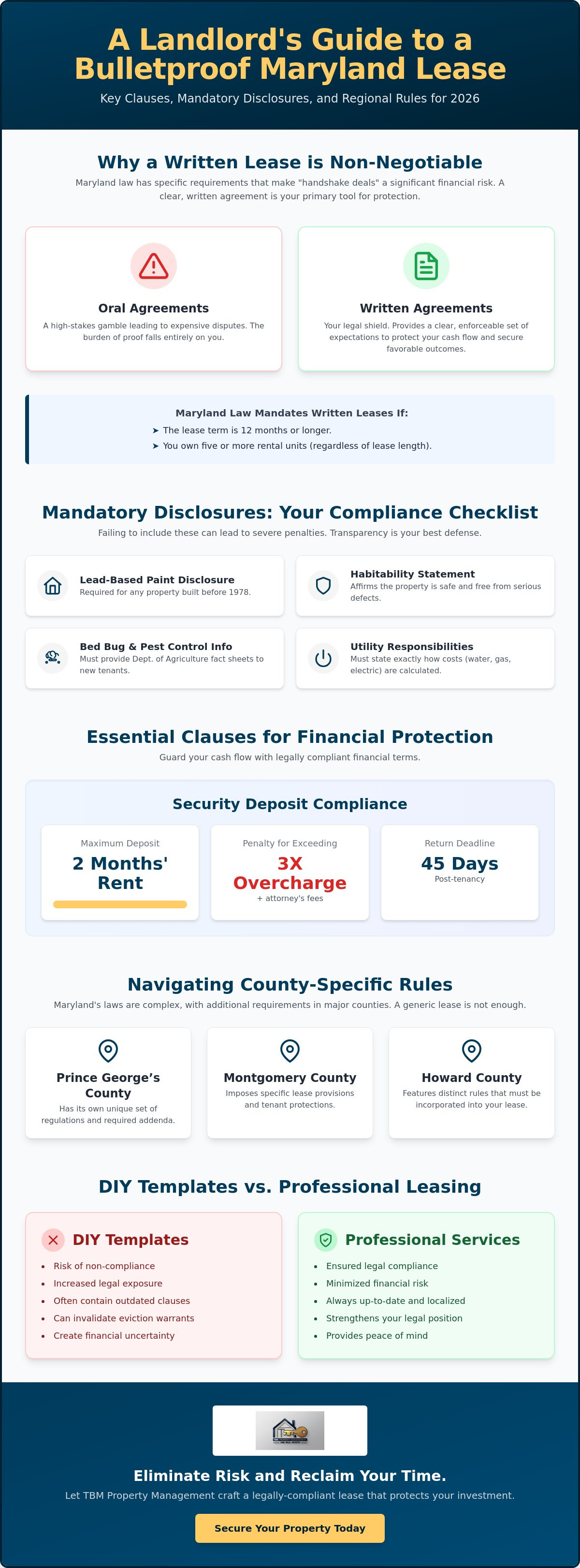
In 2026, the "1-year rule" remains a critical boundary for your business. Maryland law mandates that any lease with a term of 12 months or longer must be in writing. Additionally, if you own five or more rental units, written agreements are non-negotiable regardless of the lease length. Beyond the legal requirement, a written residential rental agreement acts as a stabilizing force for your professional relationship. It replaces the anxiety of "handshake" deals with a clear, enforceable set of expectations. You should also remember that you're legally required to provide a copy of the lease to a prospective tenant upon request without requiring a deposit or fee for the privilege of reading it.
Oral vs. Written Leases in 2026
Does a verbal agreement hold water in a Maryland courtroom? Technically, yes, for short-term arrangements under one year. However, relying on oral terms is a high-stakes gamble that often leads to expensive disputes. Without a physical contract, the burden of proof rests on your shoulders. If a tenant disputes a utility payment or a maintenance responsibility, a judge has no baseline to follow. A written lease is the only way to effectively prove terms, protect your cash flow, and secure a favorable outcome in a legal setting. It transforms a potentially volatile situation into a structured, professional interaction.
The Habitability Covenant
Every lease in the state includes an implied warranty of habitability, which is a promise that the property is safe for living. You must include specific language acknowledging the condition of the premises at the start of the tenancy. This isn't just a formality; it's a protective shield for both parties. In 2026, Maryland habitability requirements mandate that landlords maintain all structural components, plumbing, electrical, and heating systems in good working order to ensure the property remains free from conditions that seriously threaten the health or safety of occupants. Clearly stating these standards in your agreement helps prevent future claims of neglect or rent escrow filings.
Mandatory Maryland Lease Provisions and Disclosures
Creating a compliant lease requires more than just listing the rent amount and the duration of the stay. When deciding what to include in a maryland rental agreement, you must account for several mandatory disclosures that protect you from future liability. Failing to include these isn't just a minor oversight; it can lead to severe penalties or even the forfeiture of your right to withhold damages from a security deposit. For instance, federal law requires a lead-based paint disclosure for any property built before 1978. Beyond federal rules, Maryland requires you to provide Department of Agriculture fact sheets regarding bed bugs and pest control to every new tenant before they sign.
Transparency is your best defense against disputes. You must provide a clear statement regarding the habitability of the unit, affirming that the property is free from conditions that endanger life, health, or safety. This includes functional plumbing, electricity, and heat. If you're managing multiple units, you must also be incredibly specific about utility responsibilities. Whether you're charging for water, gas, or electric, the lease must state exactly how these costs are calculated and who is responsible for the bill. If you need help organizing these complex requirements, our leasing services can provide a structured framework that ensures no disclosure is left behind.
Security Deposit Compliance
Maryland law is very specific regarding security deposits. The maximum you can charge is two months' rent. If you exceed this limit, you could be liable for three times the extra amount charged, plus attorney's fees. You must provide a written receipt immediately upon receiving the deposit. This receipt must inform the tenant of their right to have the property inspected within 15 days of occupancy and their right to be present at the final move-out inspection. Remember, you have exactly 45 days after the lease ends to return the deposit with interest, as outlined in the Maryland Attorney General's Landlord-Tenant Guide. Failing to provide the required written receipt can strip you of your right to keep any portion of the deposit for damages.
Utility and Repair Disclosures
Ambiguity is the enemy of a profitable rental. You must explicitly define who pays for heat, gas, electric, and water to avoid "grey area" disputes. If you use a Ratio Utility Billing System (RUBS) to split costs among multiple units, Maryland law requires a specific disclosure explaining the calculation method. It's also vital to clarify repair responsibilities. While you're responsible for major structural issues and systems, you can assign certain minor maintenance tasks to the tenant. Understanding landlord tenant rights maryland is essential for setting these boundaries correctly. This ensures your tenant knows when to call you and when to pick up a wrench, saving you from unnecessary service calls.
Essential Clauses to Protect Your Investment and Cash Flow
How do you ensure your rental income remains predictable while protecting your physical asset from avoidable damage? It starts with the specific language in your contract. When considering what to include in a maryland rental agreement, you must move beyond basic templates that often miss the nuances of enforcement. A well-drafted lease doesn't just list rules; it provides a roadmap for resolving friction before it turns into a costly dispute. By establishing clear boundaries early, you can transition from a state of constant oversight to a state of ease and confidence.
One of the most vital areas for protection is your right of entry. While Maryland law doesn't specify a mandatory notice period, establishing a "reasonable notice" clause, typically 24 to 48 hours, in your Maryland lease provisions is a best practice that respects tenant privacy while ensuring you can conduct inspections and repairs. This proactive approach prevents small maintenance issues from ballooning into major expenses. Your pet policy must also be explicit. In 2026, you must distinguish between standard pets and Emotional Support Animals (ESAs), which are protected under fair housing laws and generally exempt from pet rent or deposits.
Rent Collection and Late Fee Structures
Protecting your cash flow requires a firm but fair late fee structure. Maryland law is clear: late fees are capped at 5% of the monthly rent. If your rent is $2,000, your maximum penalty is $100. It's also wise to define acceptable payment methods to avoid "the check is in the mail" excuses. Many landlords find that professional tenant placement services are the best way to ensure you're starting with reliable residents who respect these timelines. Remember, if rent isn't paid, you must provide a 10-day notice to pay or quit before you can initiate legal proceedings.
Property Care and Maintenance Standards
Distinguishing between tenant-caused damage and normal wear and tear is a common source of frustration. Your lease should explicitly state that tenants are responsible for minor upkeep, such as replacing light bulbs or air filters. Requiring renters insurance is another essential layer of protection; it shifts the liability for a tenant's personal property and certain damages away from your policy. Integrating streamlined property maintenance protocols directly into the lease language helps set expectations for how repairs are reported and handled. This clarity reduces the emotional burden of management and keeps your property in peak condition.
Regional Requirements: PG County, Montgomery, and Howard Nuances
Does your portfolio span across multiple county lines? If so, you've likely realized that Maryland is far from a monolith. When deciding what to include in a maryland rental agreement, you must look beyond state statutes to the specific ordinances of your local jurisdiction. Managing a property in Laurel, for example, requires a high level of diligence because the city spans Prince George’s, Anne Arundel, Howard, and Montgomery counties. A lease that is perfectly legal on one side of a street might be non-compliant on the other. This complexity is exactly why we prioritize hyper-local expertise to provide the stabilizing force your investments need.
Local mandates often provide stricter tenant protections than state law. If you overlook a county-specific disclosure, you might find your lease unenforceable in a local Rent Court. This is particularly true in areas with active housing departments that require specific addendums or registration numbers to be printed directly on the contract. To ensure your assets remain protected, you must integrate these regional nuances into your standard operating procedures. If the burden of tracking these shifting rules feels heavy, choosing professional property management is a proven way to shift that responsibility to a dedicated partner.
Prince George’s County Specifics
Landlords in Prince George’s County face a unique set of licensing requirements. You must include your valid rental license number in the lease agreement to legally collect rent or initiate an eviction for non-payment. Additionally, the county has specific habitability standards regarding cooling and heating that exceed the basic state requirements. While the state caps late fees at 5%, Prince George’s County strictly mandates that this 5% penalty cannot be applied until the rent is more than five days late. Failing to respect this grace period can lead to administrative fines and legal setbacks.
Montgomery and Howard County Variations
Montgomery County is perhaps the most regulated jurisdiction in the state. You are required to provide a mandatory "Lease Summary" with every agreement, and you must offer tenants a two-year lease term at both the initial signing and at renewal, unless you have a documented, valid reason to offer a shorter term. Certain tenants also have a "Right of First Refusal" to purchase the property if you decide to sell. In Howard County, notice requirements are the primary focus; you must provide 90 days' written notice for any rent increase. Howard County also utilizes a unique mediation process through the Office of Consumer Protection that you should account for in your dispute resolution clauses. To stay ahead of these local variations and protect your cash flow, contact us today for a comprehensive review of your leasing strategy.
Why Professional Leasing Outperforms DIY Templates
Are you still relying on a generic lease template you found online several years ago? In the shifting legal climate of 2026, using an outdated document is a significant financial risk. Since the Renters' Rights and Stabilization Act took effect, Maryland has seen a surge in tenant protections that can render old clauses not only void but potentially illegal. When you're deciding what to include in a maryland rental agreement, the difference between a "good enough" template and a professionally drafted contract can be the difference between a smooth tenancy and a courtroom disaster. We help you move from a state of legal anxiety to a state of total confidence.
Professional leasing turns your agreement from a static piece of paper into a proactive management system. We don't just provide a document; we provide a comprehensive framework for success. This includes conducting rigorous tenant screening that complies with the $25 application fee limit while identifying high-quality residents who respect your property. By ensuring every mandatory disclosure and protective clause is current, we help you avoid the common pitfalls of self-management. This level of detail is exactly what transforms a burdensome asset into a stabilizing, high-performing source of wealth.
The TBM Advantage in Laurel and Beyond
With over 12 years of dedicated experience across Anne Arundel, Prince George’s, and Montgomery Counties, we understand the hyper-local nuances that DIY landlords often miss. Whether you are navigating the two-year lease offer rules in Montgomery County or the specific licensing requirements in Laurel, we handle the heavy lifting for you. Our team manages the complexities of rent collection and periodic property inspections, ensuring your investment remains in peak condition. The true value of a full-service property management partner is the relief of knowing your assets are protected by experts who live and work in your community.
Next Steps for Maryland Landlords
It's time to take a hard look at your current leasing strategy. Does your agreement still include prohibited provisions that could lead to administrative fines? Are you confident that your security deposit receipts meet the strict 2026 standards? We invite you to move from a state of uncertainty to a state of ease. Start by reviewing your existing documents for any language that contradicts current state or county statutes. This proactive step is essential for minimizing your financial risk and maintaining a professional standard of service.
If you want the security of a bulletproof lease without the stress of constant legal research, we are here to act as your dedicated partner. Our local experts are ready to provide the professional-grade results you deserve. Get your free Maryland rental analysis from TBM today! and discover how we can simplify your management process while maximizing your returns.
Securing Your Rental Legacy with Confidence
Managing a rental property in 2026 requires more than just good intentions; it demands a precise, localized strategy. We've explored the importance of the written framework, the mandatory safety disclosures, and the complex regional nuances that differ across county lines. Understanding what to include in a maryland rental agreement is the first step toward transforming your property from a source of stress into a stable, high-performing asset. You don't have to navigate these shifting legal waters by yourself.
Our team brings over 12 years of local Maryland expertise to your portfolio, serving landlords throughout Prince George’s, Montgomery, Howard, and Anne Arundel Counties. We specialize in comprehensive tenant screening and placement, ensuring your lease is backed by reliable residents and total legal compliance. By shifting the burden of asset oversight to a seasoned partner, you can focus on your long-term goals while we handle the fine print. Let TBM Property Management draft your compliant Maryland lease today! and experience the professional-grade relief you've been searching for. Your peace of mind is just a conversation away.
Frequently Asked Questions
What is the maximum security deposit a landlord can charge in Maryland?
The maximum security deposit you can charge in Maryland is two months' rent. If you accidentally charge more than this limit, you could be held liable for three times the extra amount plus the tenant's attorney's fees. It's essential to keep this strict limit in mind when determining what to include in a maryland rental agreement to stay fully compliant with state law and protect your business.
Does a Maryland rental agreement have to be in writing?
A written lease is mandatory in Maryland if the term is for 12 months or longer, or if you own five or more rental units. While oral leases for shorter terms are technically legal, they offer almost no protection in a courtroom setting. We always recommend a detailed written document to ensure all responsibilities are clearly defined, providing a stabilizing force for both you and your tenant.
Can a landlord charge a late fee in Maryland, and is there a limit?
Yes, Maryland law caps late fees at 5% of the monthly rent amount. For landlords who collect rent on a weekly basis, the limit is $3 per week, with a maximum total of $12 per month. You must explicitly state these fees and the date they apply within your lease document to collect them legally. This clarity helps prevent financial friction and ensures a predictable cash flow for your investment.
What disclosures are required for a Maryland lease in 2026?
Your 2026 lease must include several key disclosures, such as a security deposit receipt and a habitability statement. You're also required to provide the Maryland Tenants' Bill of Rights and Department of Agriculture bed bug fact sheets. For properties built before 1978, the federal lead-based paint disclosure is a non-negotiable requirement for legal compliance. Including these ensures you meet the high standards expected of professional property owners.
How much notice must a Maryland landlord give for a rent increase?
You must provide 90 days' written notice for a rent increase if the tenancy is longer than one month. For shorter tenancies that last between one week and one month, the required notice period is 60 days. Providing this notice in a clear, written format helps you avoid unnecessary disputes and maintains a professional, respectful relationship with your residents as they plan for their future housing costs.
Are there specific lease requirements for Prince George’s County?
Landlords in Prince George’s County must include their rental license number directly in the lease agreement. Additionally, the county mandates a five-day grace period before a late fee can be charged. This differs from the state's general interpretation, making it vital to understand local nuances when deciding what to include in a maryland rental agreement. Failing to include these specifics can lead to administrative fines or delays in court.
What happens if a Maryland lease contains prohibited provisions?
If a lease contains prohibited provisions, those specific clauses are considered void and unenforceable by a Maryland court. While the rest of the lease agreement usually remains valid, using illegal clauses can expose you to costly lawsuits for damages or tenant attorney's fees. This is a primary reason why many local landlords choose professional leasing services to ensure their contracts are bulletproof and fully compliant with current regulations.
How long does a landlord have to return a security deposit in Maryland?
You have exactly 45 days after a tenant moves out to return the security deposit. This return must include any interest earned and a written, itemized list of any deductions made for damages. Failing to meet this strict deadline can result in you losing the right to withhold any portion of the deposit, even if the tenant caused significant damage to your property during their stay.